The Problem
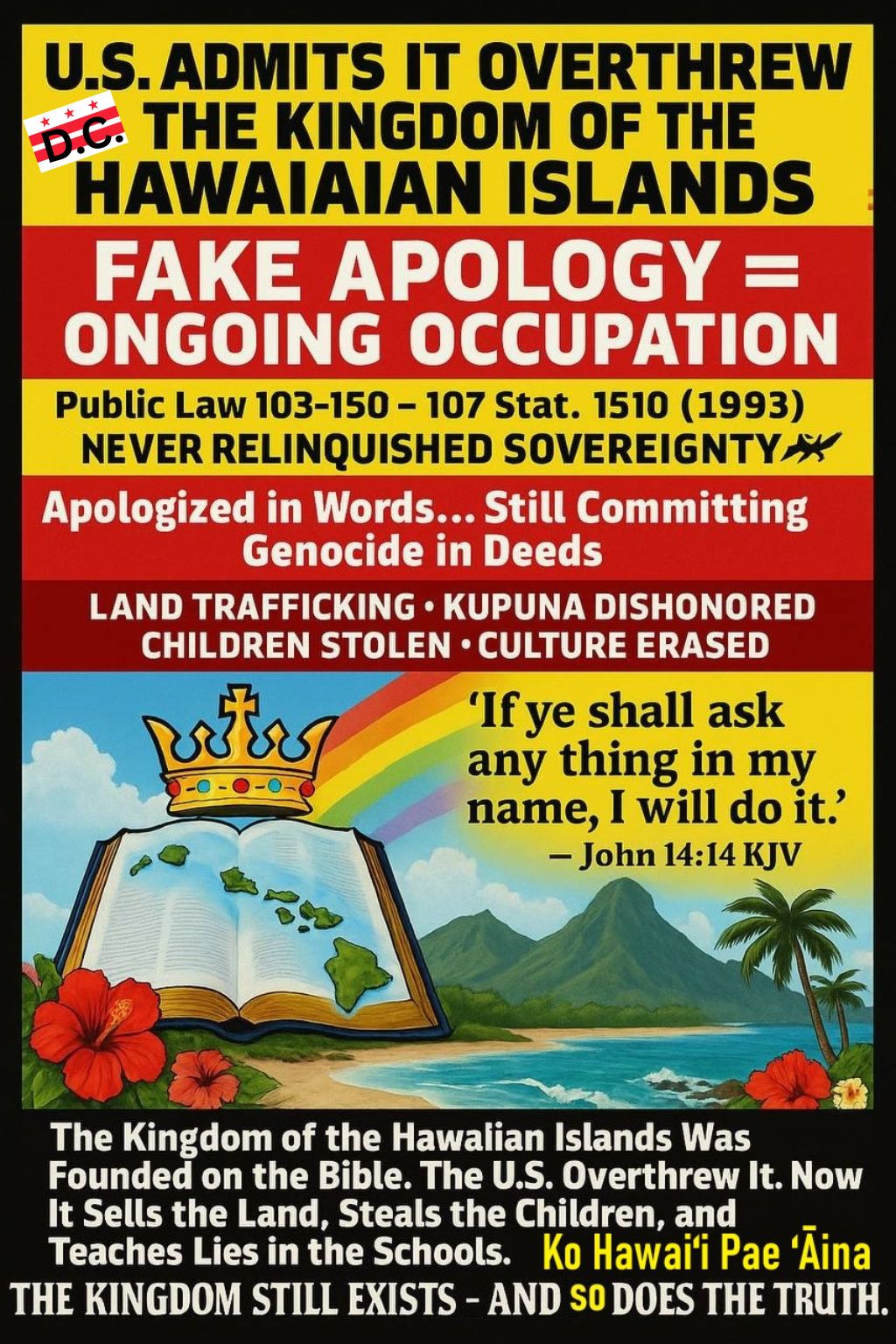
In 1993, the United States Congress issued an apology under Public Law 103-150, admitting that the Kingdom of Hawaii was overthrown with the participation of U.S. agents—and that Native Hawaiians never lawfully gave up their sovereignty or their national lands. And yet... the occupation continues.
This website exists to restore voice, truth, and remedy to the Hawaiian people. The Kingdom of the Hawaiian Islands was a lawful, sovereign nation. Its Constitution of 1840, its Civil Code of 1859, and its deeply rooted kanawai (laws)—which are biblically based—and are still the true law of this land. The KJV Bible is the law book for the Kingdom of the Hawaiian Islands.
“Behold my servant, whom I uphold: mine elect, in whom my soul delighteth; I have put my spirit upon him: he shall bring forth judgment unto the Gentiles. He shall not cry nor lift up, nor cause his voice to be heard in the streets. A bruised reed shall he not break, and the smoking flax shall he not quench: he shall bring forth judgment unto truth. He shall not fail nor be discouraged, till he have set judgment in the earth: and the isles shall wait for his law. 13LtMs, Ms 23, 1898, par. 13
About the Apology Resolution
Public Law 103-150 (PDF)
Wikipedia Summary
Adopted on November 23, 1993, the U.S. government [Washington, DC, (District of Columbia) NOT A STATE!] formally apologized to the Hawaiian people for its illegal overthrow of the Kingdom of Hawaii in 1893. Yet despite the apology, the theft of land, land trafficking, theft of humans, human trafficking, the stripping of rights, and the forced CORPORATION legal fiction called the "STATE OF HAWAII" continue.
"There is a principle which is a BAR against all information, which is used as 'PROOF' against all arguments; and which cannot fail to keep man in everlasting ignorance; that principle is condemnation before investigation." Herbert Spencer
Because of the Federal Record of Congress 13 Statutue 223, page 306 Chap. 173, Section 182 [go to/turn to image 306] June 30, 1864: territory; which killed state sovereignty/jurisdiction, affecting 37 states, what STATE really has true, Constitutional jurisdiction? /Case: See 9-10-2015 Houston-Lufkin Tax Division case in PDF here, and link to online case here = DECOPAGE!!! Page 306: Sec . 182. "Word “state” to include “ territories,” and District of Columbia", "And be it further enacted, That wherever the word state is used in this act, it shall be construed to include the territories and the District of Columbia, where such construction is necessary to carry out the provisions of this act. Approved, June 30, 1864."
![Federal Record of Congress 13 Statutue 223, page 306 Chap. 173, Section 182 [go to/turn to image 306] June 30, 1864; Page 306: Sec . 182. -Word -state- to include -territories,- and District of Columbia](/images/Federal-Record-of-Congress-13-Statutue-223,-page-306-Chap.-173,-Section-182-go-to-turn-to-image-306-June-30,-1864.jpg)
"EVERY taxpayer is a Cestui Que Trust [A Cestui Que Trust is a piece of paper and not you a living human with arms and legs] having sufficient interest in preventing abuse of the trust to be recognized in the field of this court's prerogative jurisdiction as relator in the proceedings to set sovereign authority in motion by action" (State of Wisconsin upon the Relation of Harry W. Bolens, Plaintiff in Error, v. James A. Frear, Secretary of State of the State of Wisconsin, Andrew H. Dahl, State Treasurer, et al., 231 U.S. 616 (1913)). Full Citation: State of Wisconsin upon the Relation of Harry W. Bolens, Plaintiff in Error, v. James A. Frear, Secretary of State of the State of Wisconsin, Andrew H. Dahl, State Treasurer, et al., 231 U.S. 616 (1913). Available at: Legal Information Institute. Wisconsin ex rel. Bolens v. Frear, Opinion of the Court. Available at: Wikisource. (Wisconsin ex rel. Bolens v. Frear - Opinion of the Court). This decision highlights the concept that public office is indeed a public trust, emphasizing the fiduciary duty public officials owe to the public. It underscores the legal standing of taxpayers to initiate actions to prevent misuse or abuse of public trust, reinforcing their role as beneficiaries with a vested interest in the proper administration of government duties. When you think about that “EVERY TAX PAYOR IS A CESTUI QUE TRUST” and a Cestui Que Trust is a piece of paper -your social security beneficiary account- then it can’t be a living human being with arms and legs and a living soul (body plus breath equal a living soul)!
- 1840 Constitution of the Hawaiian Kingdom
-
Public Law 103-150 (U.S. Apology Resolution)
— To acknowledge the 100th anniversary of the January 17, 1893 overthrow of the Kingdom of Hawai‘i, and to offer an apology to Native Hawaiians on behalf of the United States.
Note: The “United States” referenced herein refers to the Title 28 U.S. Code § 3002 – Definitions (15)(A), defining "UNITED STATES" as a federal corporation usurping as the new Rome Vatican occupation as the District of Columbia, a separate government similarly named "UNITED STATES" created by the Act of 1871 not to exceed 10 square miles. - Natural rights acknowledged under customary and international law
The Remedy
The remedy is restoration—not simulation. The Hawaiian Bible was the foundation of Hawaiian law, and sovereignty rests with the people, not a corporate fiction. Hawaiians have the right to assert their national identity, protect their ʻohana, and reclaim stolen ʻāina.
📜 Hawaiian Kingdom Legal Foundation
This sovereign protection is grounded in the 1840 Constitution of the Ko Hawaiʻi Pae ʻĀina the Kingdom of the Hawaiian Islands, which states:
"God hath made of one blood all nations of men to dwell on the earth, in unity and blessedness. God has also bestowed certain rights alike on all men and all chiefs, and all people of all lands. These are some of the rights which He has given alike to every man and every chief of correct deportment; life, limb, liberty, freedom from oppression; the earnings of his hands and the productions of his mind..."
— ibid 1840 Constitution of the Hawaiian Kingdom (HarveyKuKeliikoa.com
"It is therefore our fixed decree, That no law shall be enacted which is at variance with the word of the Lord Jehovah, or at variance with the general spirit of His word."
— ibid
Grievances Against the U.S. Occupiers
- Unlawful overthrow of the Hawaiian Kingdom (1893)
- Fraudulent annexation and statehood
- Land trafficking and illegal foreclosures
- Child and human trafficking under the guise of corporate government
- Continued denial of Hawaiian sovereignty despite Public Law 103-150
Slavery by Currency: The Great Hawaiian Betrayal
The Kingdom of the Hawaiian Islands operated on real money—gold and silver. This was the lawful standard of exchange, rooted in justice, honest trade, and biblical law. In economic terms, "fiat currency" refers to money that has value because a government declares it legal (not lawful) tender, not because it is backed by a physical commodity like gold.
The U.S. occupiers abolished this system, replacing it with a fiat currency created from nothing—backed not by gold, not by silver, but by debt and coercion.
18 U.S. Code § 1583 – Enticement into Slavery:
“Whoever kidnaps, entices, decoys, or carries away any other person, with intent that such other person be held as a slave… shall be fined… or imprisoned…”
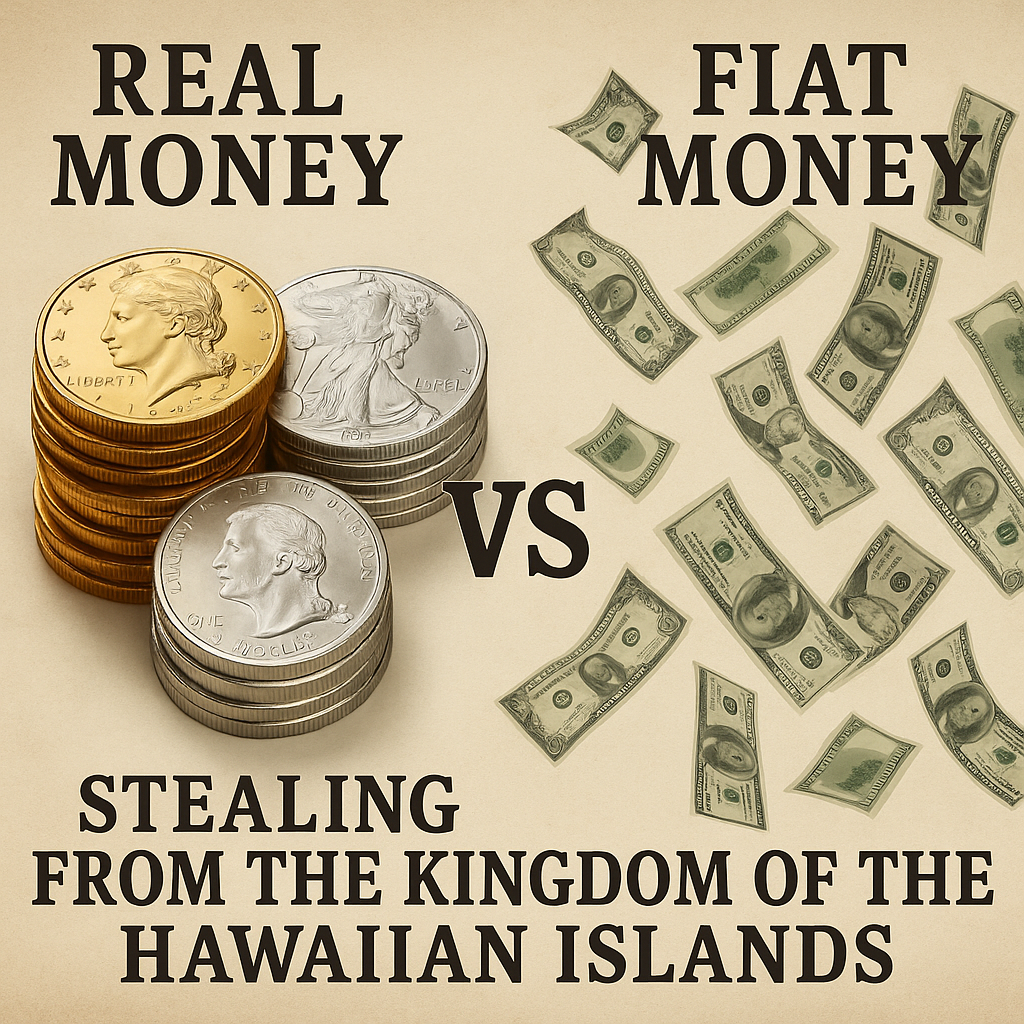
The modern plantation isn't sugar. It's debt-based money. The U.S. has turned Hawaiians into economic slaves, forced to labor under a fake legal entity (“State of Hawaii”) with no gold, no sovereignty, and no lawful consent. This is not freedom—it’s fiat bondage.
The Public Law 103-150
Court: Intermediate Court of Appeals of Hawaii Anthony Lorenzo, a proud Native Hawaiian, stood against the illegal occupying force masquerading as the “State of Hawaii.” His alleged “crime”? Driving without a license — an alleged offense committed under a jurisdiction Lorenzo boldly declared as invalid and fraudulent. Lorenzo invoked the truth that the Kingdom of Hawai‘i, unlawfully overthrown in 1893 by U.S.-backed insurgents, had never lawfully ceded sovereignty. Therefore, the U.S.-created State of Hawaii and its puppet judiciary possessed zero lawful authority over him or any Kanaka Maoli. The corrupt corporate (co-pirate) court did not refute Lorenzo’s central claim that the Kingdom still lawfully exists — instead, it cowardly dismissed the case by declaring that he didn’t present “enough evidence.” This is the tell-tale tactic of a system trying to bury the truth without exposing itself to the light of lawful examination. This case is not a defeat — it’s a roadmap. The corrupt court never disproved the Kingdom’s continued existence. It merely hid behind procedural technicalities to avoid confronting the monster under its robe — colonial occupation by legal fiction. To this day, no court has dared to honestly rule on the legitimacy of the Hawaiian Kingdom — because doing so would implode the entire U.S. empire of fraud in the Pacific. The Kingdom of the Hawaiian Islands lawfully exists under international law. The U.S. knows it. The courts know it. And one day, the world will know it — and stand to see justice done. 📜 Read Public Law 103-150 — The U.S. Apology for the Overthrow (1993) Ko – possessive particle, here meaning “of” or “belonging to” Hawaiʻi – the Hawaiian islands Pae ʻĀina – “archipelago” or “group of lands/islands” So, “Ko Hawaiʻi Pae ʻĀina” means:
Reach out with documentation, talk stories, or support:Research Tools
🔥 Sovereignty Suppressed: State v. Lorenzo (1994)
Date: October 27, 1994
Citation: 77 Haw. 219, 883 P.2d 641🧑🏽⚖️ Background
⚖️ Court’s Evasion, Not Refutation
“Lorenzo did not present any evidence that the Kingdom of Hawai‘i is currently recognized by the United States or any other entity as a sovereign nation.”
🔥 Translation: The U.S. doesn’t recognize it — therefore we won't. Truth doesn’t matter. Occupation stands.
🚨 Exposing the Hidden Treason
🧠 True Significance
📚 Legal Legacy
🌺 Understanding “Ko Hawaiʻi Pae ʻĀina”
Contact
Email: Aloha@PublicLaw103150.com